If you’ve tried this and still can’t sign in, contact your local office or email info@richardsonmediagroup.net.


Where Americans are broke: 2026 study

Having a negative net worth means a household owes more than it owns, and high debt relative to assets is associated with greater perceived depression, more stress and poorer health. For nearly two decades before the Great Recession, the share of U.S. households whose debts equaled or exceeded their assets held fairly steady, then rose sharply after 2008. Today, that share varies by state.
SmartAsset analyzed the share of households in each state with zero or negative net worth and compared it with the U.S. rate of 11.3%. Because survey results carry margins of error, a state is rated higher or lower only when the difference is too large to be attributed to sampling error alone. A household with no wealth behind the paycheck is vulnerable in any state, and this study shows how common that vulnerability is across the country.
Key Findings
- Three states have a significantly larger share of households with zero or negative net worth than the U.S. overall. In Oklahoma, Mississippi and New York, the estimated share of households with zero or negative net worth differs from the national rate of 11.3% by more than sampling error.*
- Six states have a significantly smaller share of households with zero or negative net worth than the U.S. overall. In California, Hawai‘i, Idaho, New Mexico, Pennsylvania and Washington, the estimated share of households with zero or negative net worth differs from the national rate of 11.3% by more than sampling error.*
- “Bankruptcy belt” states are among those with high shares of low-net-worth households. While having zero or negative net worth does not, by itself, suggest that insolvency is near, three of the four states that comprise America’s “bankruptcy belt” — Alabama, Mississippi and Tennessee — appear among the 10 states with the largest estimated shares of households with zero or negative net worth.
- About half of states move further into the red. The year-over-year change in the share of households with zero or negative net worth increased in 22 of the 43 states measured. However, minor year-over-year differences should be interpreted with caution because the estimates are subject to sampling variability.
* Statistically significant at the 90% confidence level
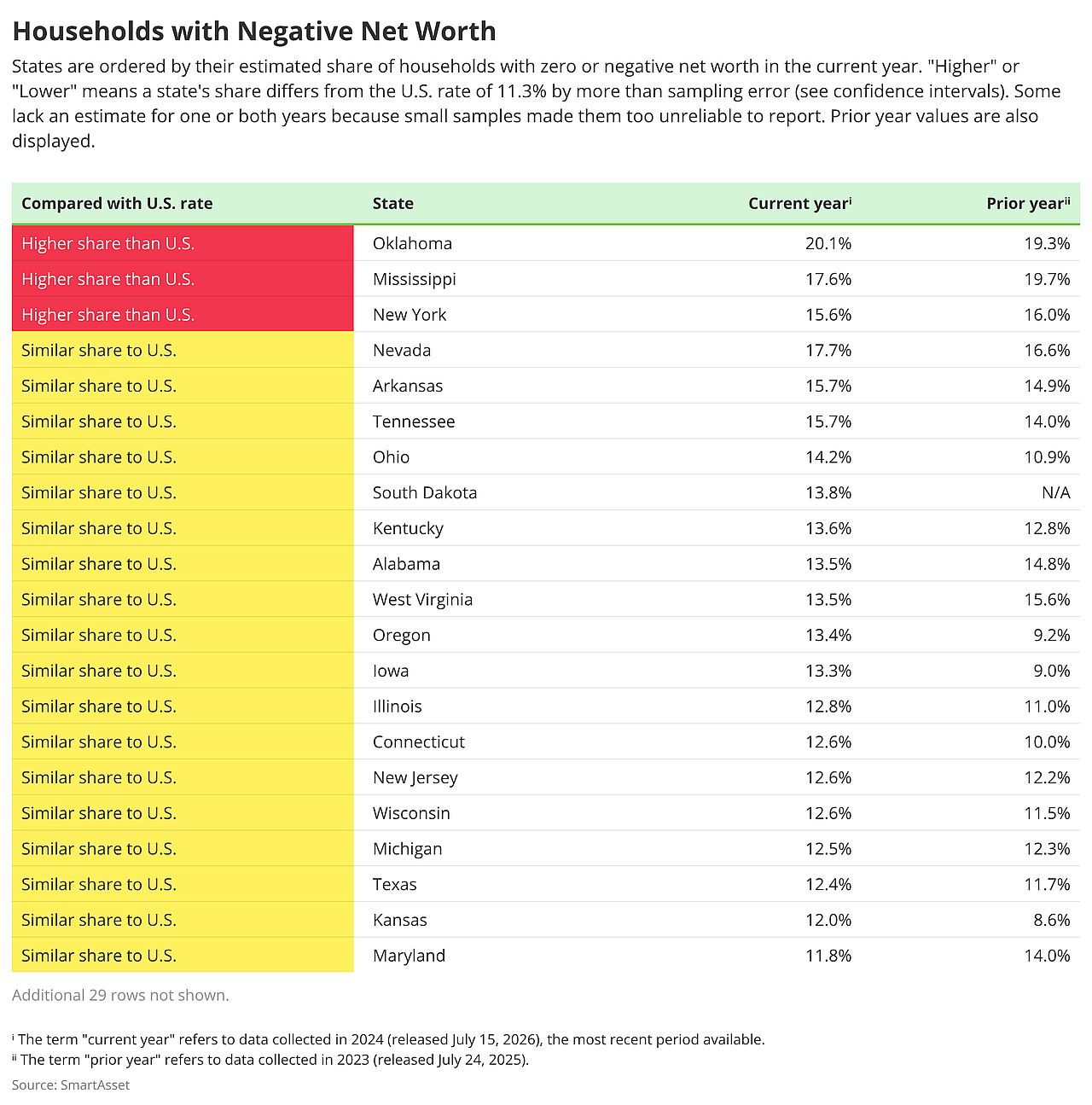
Households With Zero or Negative Net Worth
- Alabama: 13.5% of households (90% confidence interval: 7.7% to 19.3%)
- Arizona: 10.6% (90% confidence interval: 5.3% to 15.9%)
- Arkansas: 15.7% (90% confidence interval: 10.9% to 20.5%)
- California: 7.3% (90% confidence interval: 6% to 8.6%)
- Colorado: 9% (90% confidence interval: 5.5% to 12.5%)
- Connecticut: 12.6% (90% confidence interval: 6.3% to 18.9%)
- Florida: 11.6% (90% confidence interval: 9.5% to 13.7%)
- Georgia: 11.6% (90% confidence interval: 9% to 14.2%)
- Hawai‘i: 4.1% (approximate 90% confidence interval: 0% to 9%)
- Idaho: 5.6% (90% confidence interval: 2% to 9.2%)
- Illinois: 12.8% (90% confidence interval: 9.8% to 15.8%)
- Indiana: 8.8% (90% confidence interval: 5.2% to 12.4%)
- Iowa: 13.3% (90% confidence interval: 7% to 19.6%)
- Kansas: 12% (90% confidence interval: 5.3% to 18.7%)
- Kentucky: 13.6% (90% confidence interval: 9.3% to 17.9%)
- Louisiana: 10% (90% confidence interval: 7.5% to 12.5%)
- Maine: 10.3% (approximate 90% confidence interval: 0% to 22.5%)
- Maryland: 11.8% (90% confidence interval: 8.2% to 15.4%)
- Massachusetts: 11.1% (90% confidence interval: 7.6% to 14.6%)
- Michigan: 12.5% (90% confidence interval: 8.9% to 16.1%)
- Minnesota: 9.1% (90% confidence interval: 6.1% to 12.1%)
- Mississippi: 17.6% (90% confidence interval: 12% to 23.2%)
- Missouri: 9.7% (90% confidence interval: 4.8% to 14.6%)
- Montana: 8.6% (90% confidence interval: 4.5% to 12.7%.
- Nevada: 17.7% (90% confidence interval: 8.2% to 27.2%)
- New Hampshire: 7% (90% confidence interval: 2.1% to 11.9%)
- New Jersey: 12.6% (90% confidence interval: 8.3% to 16.9%)
- New Mexico: 6% (90% confidence interval: 1.2% to 10.8%)
- New York: 15.6% (90% confidence interval: 13.1% to 18.1%)
- North Carolina: 11.1% (90% confidence interval: 8.5% to 13.7%)
- Ohio: 14.2% (90% confidence interval: 9.9% to 18.5%)
- Oklahoma: 20.1% (90% confidence interval: 13.5% to 26.7%)
- Oregon: 13.4% (90% confidence interval: 9% to 17.8%)
- Pennsylvania: 7.8% (90% confidence interval: 5% to 10.6%)
- South Carolina: 10.9% (90% confidence interval: 7.4% to 14.4%)
- South Dakota: 13.8% (approximate 90% confidence interval: 0% to 28.1%)
- Tennessee: 15.7% (90% confidence interval: 10.9% to 20.5%)
- Texas: 12.4% (90% confidence interval: 10.6% to 14.2%)
- Utah: 10.6% (90% confidence interval: 4% to 17.2%)
- Virginia: 8.9% (90% confidence interval: 5.4% to 12.4%)
- Washington: 8.5% (90% confidence interval: 6% to 11%)
- West Virginia: 13.5% (90% confidence interval: 5.6% to 21.4%)
- Wisconsin: 12.6% (90% confidence interval: 8.2% to 17%)
Methodology
Household net worth data come from the U.S. Census Bureau’s Survey of Income and Program Participation (SIPP). The 2024 estimates reflect household assets and debts during calendar year 2024 and were released by the Census Bureau on July 15, 2026. The 2023 estimates reflect calendar year 2023 and were released on July 24, 2025. State-level estimates for the share of households with zero or negative net worth, defined as households whose debts equaled or exceeded their assets, were analyzed. Estimates are subject to sampling variability, particularly in smaller states, so differences between years should be interpreted as approximate rather than precise. Standard errors published by the Census Bureau were used to calculate approximate 90% confidence intervals for the 2024 state estimates using the formula estimate ± 1.645 times the standard error. States were rated “Higher” or “Lower” than the U.S. rate of 11.3%, taken from the same SIPP table, when the difference exceeded 1.645 times its standard error, and “Similar” otherwise. States with suppressed data due to small sample sizes were omitted for the year of suppression. Source data providers are not affiliated with, and do not endorse or sponsor, this study or its findings.
This story was produced by SmartAsset and reviewed and distributed by Stacker.


